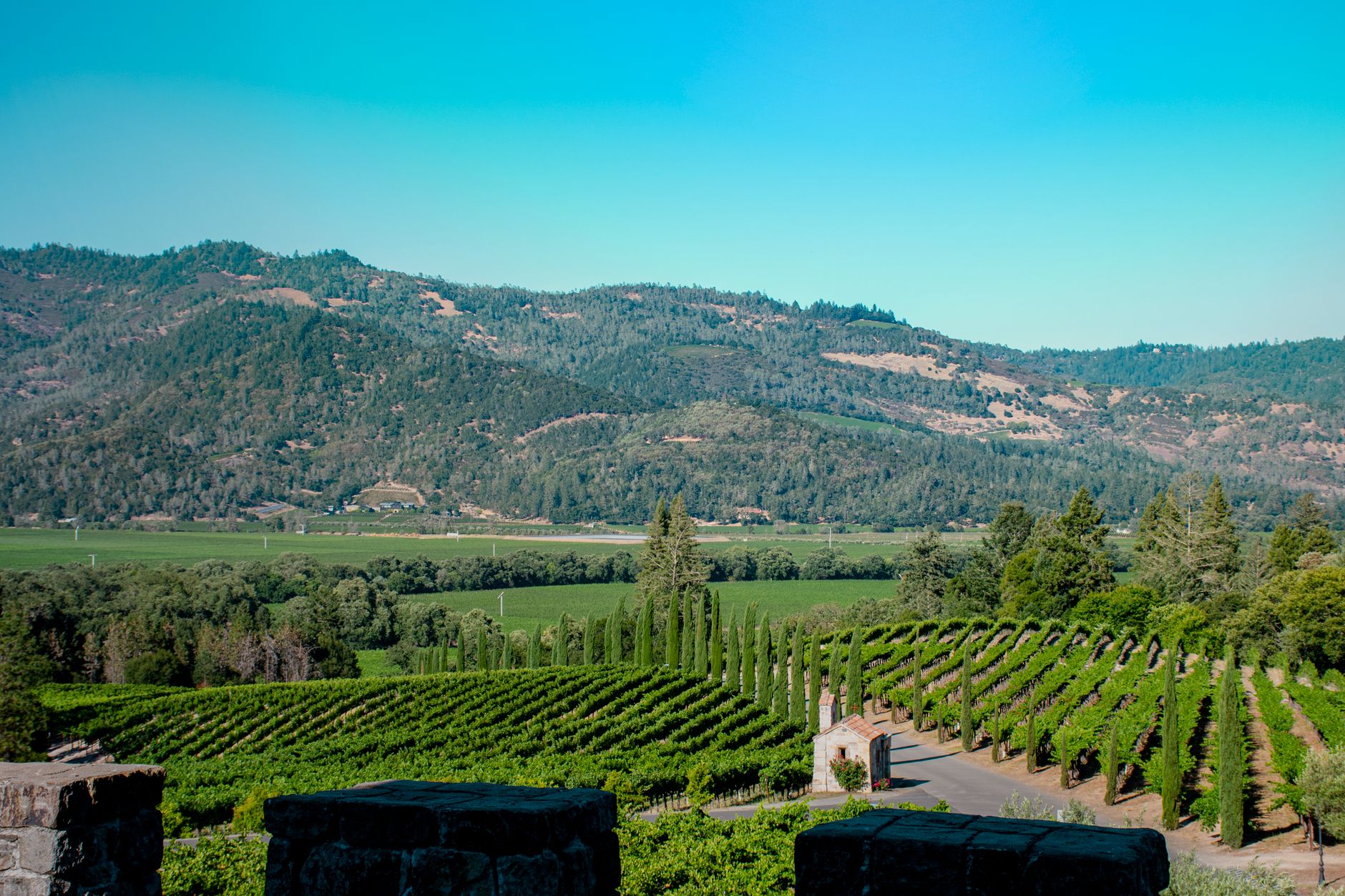
Napa Valley is best understood as a compact, highly varied valley where geography, microclimate, and AVA names shape the wines visitors encounter.
Why this region matters
Napa Valley is one of the clearest places for learning how a small wine region can contain many distinct growing conditions. The valley is often discussed through Cabernet Sauvignon, but it is not a single-style destination. Cooler southern areas, warmer valley-floor zones, mountain vineyards, and individual AVAs all influence what a visitor sees on labels and in the glass.
For EoW purposes, Napa should be presented as a map-reading region. A visitor does not need a list of famous estates to learn from Napa. The more durable lesson is how valley orientation, fog, elevation, soil variation, and appellation naming create a vocabulary for understanding California wine.
How to read the landscape
The valley runs roughly north-south, with mountains on both sides and San Pablo Bay influencing the cooler southern end. This helps explain why Carneros is associated with cooler-climate grapes such as Chardonnay and Pinot Noir, while mid-valley and northern zones are more closely associated with structured red wines.
The most useful travel habit is to look at the valley in bands: south-to-north temperature change, valley floor versus hillside, and western versus eastern exposure. These differences matter more than memorizing every winery name.
Wine styles to understand before you go
Cabernet Sauvignon is the central reference point, but Merlot, Cabernet Franc, Sauvignon Blanc, Chardonnay, Zinfandel, and other varieties are also part of the landscape. A tasting day built around contrast can show how the same grape changes across warmer and cooler sites.
Napa wine hospitality often emphasizes seated tastings and guided appointments. That format can be educational when visitors ask about vineyard source, AVA, elevation, vintage conditions, and oak use instead of treating each glass as an isolated score.
Appellations, subregions, and place names
Napa Valley itself is an AVA, and it contains nested AVAs with distinct local identities. For a Level 1 visitor, the important point is not to rank them but to understand that AVA names are legal origin terms, not automatic quality guarantees.
Oakville, Rutherford, Stags Leap District, Howell Mountain, Mount Veeder, Carneros, Calistoga, and other names can be used as anchors for learning how site, exposure, and climate show up in style.
How visits tend to work
Napa is appointment-oriented compared with many more casual wine regions. Visitors should expect structured tastings, clear reservation policies, and a hospitality environment that often requires planning.
Because costs, availability, and policies change quickly, EoW should not publish tasting-fee or appointment-specific claims in the article body. Those belong to current official visitor pages or winery sites, not evergreen encyclopedia copy.
Food, culture, and local context
Food culture in Napa is highly developed, but the wine-learning value is still in the landscape. Meals can help visitors observe how tannin, acidity, oak, and ripeness behave with food, especially in Cabernet-centered pairings.
Responsible travel should be framed plainly: use a designated driver, car service, tour operator, or other safe transportation when tasting across multiple stops.
Common mistakes to avoid
- Do not assume all Napa wine is Cabernet Sauvignon.
- Do not treat AVA names as quality tiers.
- Do not try to cover the entire valley in a single day.
- Do not rely on out-of-date tasting-fee or walk-in information.